
Life Stories
Dame Averil Millicent Cameron
Dame Averil Millicent Cameron (Warden 1994-2010) died on 7 April 2026 aged 86.
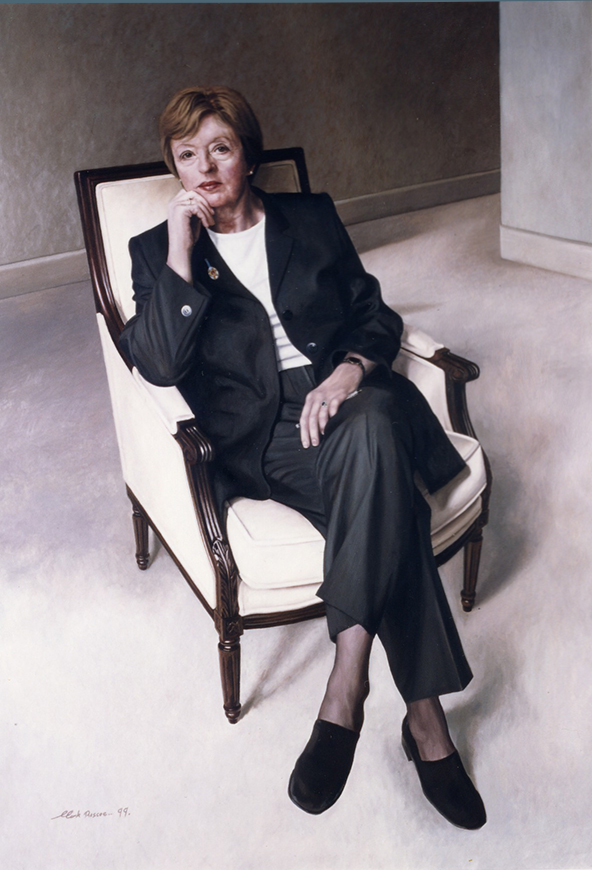
Portrait of Averil by Mark Roscoe, Keble College Dining Hall
Averil Millicent Cameron, DBE, FSA, FRHistS, FBA, the only child of Tom and Millicent (née Drew) Sutton, was born on 8 February 1940 in the north Staffordshire market town of Leek. Hers was a humble background: her father was a paper mill operative, and the family home was a two-up-two down terrace house with an outside lavatory and no hot water. There were few books – Charles Dickens’ Child’s History of England was the only History book – but she was an avid user of the Boots circulating library. At the age of ten she secured a scholarship to Westwood Hall High School, the local grammar school. Always keen on music (she had played the piano in her local Sunday school, and eventually reached grade 8), she resisted the temptation to go to music school and followed her Head Mistress’ advice to apply to Oxford, and secured an exhibition at Somerville College, Oxford to study Classics in 1958. As she has said, the idea of going to Oxford, was for her the equivalent of going to the moon.
Somerville was an intellectually conservative place but provided a good training in the close reading of classical texts, which was to stand her in good stead, and Elizabeth Anscombe was an inspirational tutor in philosophy. It was at Oxford that she met the fellow classicist, Alan Cameron, who she married in 1962. They moved to Glasgow where Alan had secured a lectureship, and Averil a graduate scholarship to pursue research on the sixth century Greek historian Agathias. By all accounts it was a very light touch supervisory regime (she was essentially self-taught), though in the closing stages of her doctoral work (now in London) she benefited from the insights of Arnaldo Momigliano, for whom she cherished a lasting admiration. In 1965 she secured her first teaching appointment at King’s College London, which was to remain her intellectual home for nearly thirty years. She became a Reader in Ancient History in 1970, and was Professor, successively of Ancient History (1978-89) and Late Antique and Byzantine Studies (1988-94). Recognition of her international standing came in invitations to various academic visiting posts in the USA and Europe, and she became a Fellow of the British Academy in 1981.
Averil somehow managed to avoid being scarred by the battles of the big beasts of the ancient history world, remaining on good terms with both Momigliano and Fergus Millar after their falling out over their differing interpretations of the workings of the Roman empire. Although her own views were often forthrightly stated and did not command universal assent, she did not get drawn into academic feuds and was always generous spirited towards fellow scholars. In her memoir, she acknowledges the galvanising effect of her friendship with Elizabeth A Clarke in developing her sympathy for cultural and linguistic approaches to texts, particularly with reference to issues of gender and asceticism. Averil’s intellectual sympathies were remarkably broad, and her work was increasingly cross-fertilised by engagement with archaeology, art history and theology. By the 1980s she was becoming more interested in early Christian texts, particularly in the way they were shaped by rhetorical conventions, and she became a leading figure in patristic studies. She was also a key figure in the British Academy funded prosopographies of the Late Roman Empire and the Byzantine world, pioneering projects in the digital humanities.
Her intellectual interests were shifting in terms of periodisation too. Rather than seeing late antiquity simply in terms of decline and collapse, she reframed the period as one of dynamic change. Rejecting orientalist assumptions, it became her mission to rescue the ‘Byzantines’ from the condescension of scholars still following in the footsteps of Edward Gibbon’s withering critique. The study of Byzantium was essential, she argued, for understanding the history of Europe and the Mediterranean region. Her work contributed to a reframing of the transition from the Roman to the medieval world.
Daniel was born in 1967, and Sophie followed four years later, but the marriage to Alan came under increasing strain. Averil herself said that they had married too young, and that they had underestimated the strains of supporting a young family while pursuing an academic career. They separated in 1977 when Alan moved to Columbia in New York and divorced in 1980. Her scholarly output is still more remarkable when we remember that she was now a working mother and a single parent.
Gender prejudice continued to be a real issue in the academy. When Averil joined King’s in 1965, they had only just allowed female academics access to the senior common room; even twenty years later, there was still a colleague who wrote her off as ‘an academic blue stocking’. She sometimes expressed regret at not having taken a more public stand on feminist issues, but many have testified that she led by her own example. She had several scarring experiences in encounters with Oxbridge colleges (at one Cambridge college she had been asked during the selection process who would preside over the fellows’ wives Christmas dinner if a ‘lady Master’ was appointed!) and was at first hesitant about allowing her name to go forward when Keble approached her about a possible candidacy for the Wardenship in 1993. In the event, the fellows made a more favourable impression. Keble was one of three colleges that year to elect a female head of house.
The impression created by Averil when she was interviewed by the Governing Body for the Wardenship in September 1993 turned out to be accurate. On the one hand, she had power-dressed for the occasion: a scarlet two-piece skirt suit with prominent black buttons. It spoke of someone who meant business and could command a situation. On the other hand, there was a tentativeness, a nervousness in her manner, revealing both an academic mindset aware of the different angles from which a problem might be addressed and also, perhaps, her humble origins in North Staffordshire.
Keble was indeed a tough challenge. Although the college had gone mixed in 1979, there was at the time of her appointment just one female fellow. Some of the fellows were pretty anti-intellectual in their outlook, and there had been damaging rifts about the place of the chapel in college life: Keble’s ‘time of troubles’, as it is still sometimes referred to. Her predecessor, George Richardson, had done much to calm divisions, but even in the year before her appointment, there had been a bruising argument over the adoption of a harassment policy, and in her first term, the Governing Body decided by a margin of one vote not to associate with the post in Theology to replace Geoffrey Rowell, the controversial former Chaplain. For some, it was a decision that had been motivated by personal antagonisms rather than academic considerations.
Averil spoke of the ‘hard men’ who tended to dominate Governing Body decision making; she made it her business to sit among them at lunch and draw their venom. She undoubtedly had an agenda: she was insistent on high academic standards; she felt that the college needed to do more to prioritise research; she wanted it to be more inclusive; and she aspired to a richer cultural life. This was never laid out in a formal ‘strategy’ document of her own. Her style was consensual, with issues sometimes being sent back to committees for further discussion rather than being forced through. She made incremental changes, took a close interest in academic appointments, and seized opportunities as they arose. She introduced the regular graduate discussion evenings, and the termly Warden’s concerts held in the Lodgings (at which she was not averse to showing off her own talents as a pianist); she was very supportive of the Chapel (in spite of her reservations about the Creed!), but insistent on the College’s support for the ordination of women, and was delighted by the appointment of Jenn Strawbridge to the Chaplaincy. With the assistance of reform-minded Senior Tutors she was able over the course of time to correct the error that had been made on Theology in 1994, such that it is now one of the most vibrant elements in the College’s intellectual culture. It is true that the decision to drop Classics on the retirement of Adrian Hollis was a matter of personal regret to her, but there was at least greater investment in Archaeology and Anthropology. Even on the organ, on which the Governing Body had resolved not to spend a penny more in 1992, her patience and tact (and the generosity of donors) meant that she eventually got her way, with the agreement to purchase a magnificent new instrument on the eve of her retirement. The collective memory of the fellows is sometimes mercifully short.
It was also under Averil’s stewardship that the College learned that in order to make money, it had to spend money. Keble had tended to wear its poverty on its sleeve, but with the assistance of Bursars, Ken Lovett and Roger Boden, two very different people, but both willing to think outside the box, the finances were slowly transformed. Investment in the college estate and in the support staff meant that conference income was boosted. A more professional attitude to fund raising also yielded dividends, and the college endowment tripled under her leadership. Her arrival at Keble coincided with the opening of the ARCO building; this was followed by the completion of the Sloane Robinson Building in 2004, with its enhanced performance spaces, energizing the arts. The College’s boldest decision was the acquisition of the Acland Hospital site in December 2004. One of Averil’s finest moments was when, on learning of a gazumping bid by St John’s, she marched down St Giles with the Bursar in tow for an eyeball-to-eyeball confrontation with the President. Keble prevailed by matching the enhanced offer and exchanging contracts with speed. It was of course, only in 2018 that the college was able to realise the full vision that had been articulated under Averil, with the opening of the H B Allen Centre, providing a new centre for the college’s postgraduate life. At the official opening the following year, Averil rightly stole the show with her striking canary coloured coat, eclipsing all the grey and navy-blue of everybody else, including the royal party. Her sense of style never deserted her.
Beyond the College, Averil made valuable contributions to University life, serving on Council, and a stint as Chair of Conference of Colleges, as well as acting as a Pro Vice-Chancellor for several years. She also served on the Cathedrals Fabric Commission of the Church of England (1996-2005), and on the Review of Royal Peculiars (1999-2001). Her account of the latter suggests that managing the Keble Governing Body was a walk in the park by comparison.
Public speaking was never really her forte, but for many old members her very vulnerability became a source of strength, and she had loyal supporters among some of the more challenging of our donors. Likewise, many students, often the more vulnerable, found in her a source of wise counsel and support.
She had continued to publish and supervise graduate students throughout her Wardenship, and there was no loss of intellectual momentum when she retired in 2010. She acted as Chair of the newly established Oxford Centre for Byzantine Studies for ten years until 2020. She continued to combine innovative interdisciplinary projects like the monograph Dialoguing in Late Antiquity (2014) with works aimed at the general reader, like Byzantine Matters (2014) and Byzantine Christianity (2017). She remained intellectually nimble and was frustrated that she had not been able to develop her ideas about the complexity of Orthodoxy more fully. Her memoir, Transitions (2024) is a wonderful evocation of her career.
Averil presided over a quiet transformation of Keble, and she did so as a person of great intellectual distinction. The affection in which she was held by the college was clear in the send off she received in 2010. The musical celebration included an adapted version of Rogers and Hammerstein’s There is Nothin’ Like a Dame, with the memorable refrain, ‘We’ll have nothing like our dame. Nothing in the world. There is nothing in the world that is anything like our dame’.
Kindly provided by Ian Archer, Robert Stonehouse Tutorial Fellow in History, with input from Michael Hawcroft, Emeritus Fellow