
Life Stories
Robert John (Bob) Morris
Robert John (Bob) Morris (1962 BA Philosophy, Politics and Economics) died on 27 October 2022 aged 79.
Bob was born in wartime Sheffield, the son of Barbara née Aston, a munitions worker, and teacher (later headmaster) George Morris. He attended Acklam Hall grammar school in Middlesbrough before moving to Oxford to read PPE at Keble in 1962. Bob claimed that it was weekly reading of The Economist that prepared him for the entrance interview where he proceeded to wax lyrical on what turned out to be the specialist subject of one of the interviewers. On later asking said interviewer why they had let him in, he was told, “you didn’t know much but you made a damn good job of arguing the points you claimed to know about.”
During his time at Keble, Bob, often accompanied by friends Mervyn Cox, Victor Kumar and Richard (Dick) Haynes, retired to the Walton Ale Stores at the corner of Kingston Road and Walton Street to complete The Times crossword. In classic Bob fashion he said it was this daily habit that led him to being awarded a first-class degree. The friends spent a summer holiday crossing Europe by train ending up in Greece.
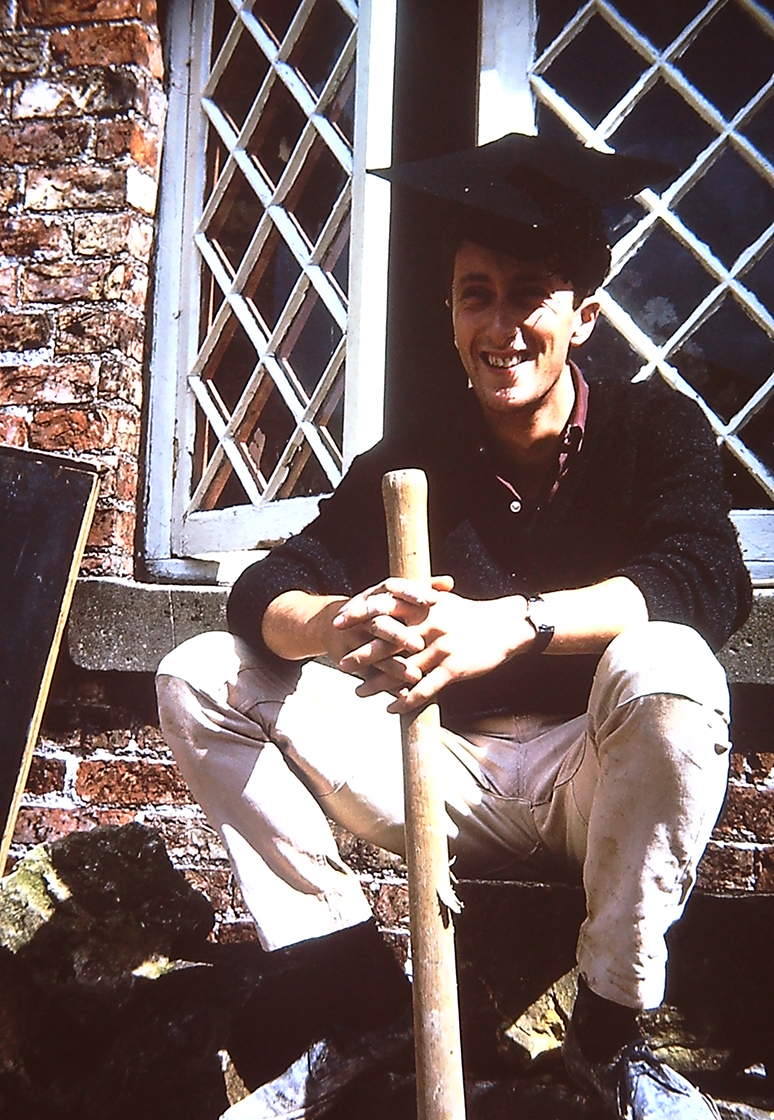
Bob has just read in The Times that he has been awarded a First Class Degree in PPE from Keble. Photo taken by his future wife Barbara McConnell during a summer excavation at the deserted medieval village of Wharram Percy in North Yorkshire.
Bob stayed in Oxford to study for a DPhil, supervised jointly by Professor H J Habakkuk (Nuffield College Oxford) and medievalist, Professor Maurice Beresford (Leeds), his research focused on middle-class secular voluntary organisations in Leeds. In 1968, before his thesis was complete, he was appointed to a lectureship at the University of Edinburgh where he developed a reputation for always being supportive and encouraging of students and early-career colleagues.
His first significant publication, Cholera 1832: The Social Response to an Epidemic (1976) arose from his interests in the middle classes living in towns, since his explanation for this tragedy of early industrialising cities pivoted on the failures of property owners and civic administrators to understand and address the diseconomies of rapid urban growth without proper sanitation. The book found a new audience in the wake of the Covid-19 pandemic and was re-issued by Routledge.
Bob’s research on 19th-century Leeds showed that a “property cycle” existed among the middle classes that was just as distinctive, and as important, as the “poverty cycle” that shaped the lives of the working classes. He argued that through property and goods, extended family networks were able to navigate the vagaries of economic change in ways that were not available to those with few assets, facing bouts of unemployment, and shorter life expectancy.
His books including Class, Sect and Party: The Making of the British Middle Class, Leeds, 1820-50 (1990) and Men, Women and Property in England 1780-1870 (2004) repositioned women as powerful elements in urban development. Meeting his future wife Barbara McConnell prompted an interest in Irish history which brought ethnicity, language and sectarianism into sharper urban focus. The year after they met, the pair undertook an intrepid journey from Aberystwyth to Athens in a mini-van studying Byzantine monasteries in former Yugoslavia en route.
Bob married Barbara McConnell in 1967 and soon celebrated the arrival of son George and daughter Helen.
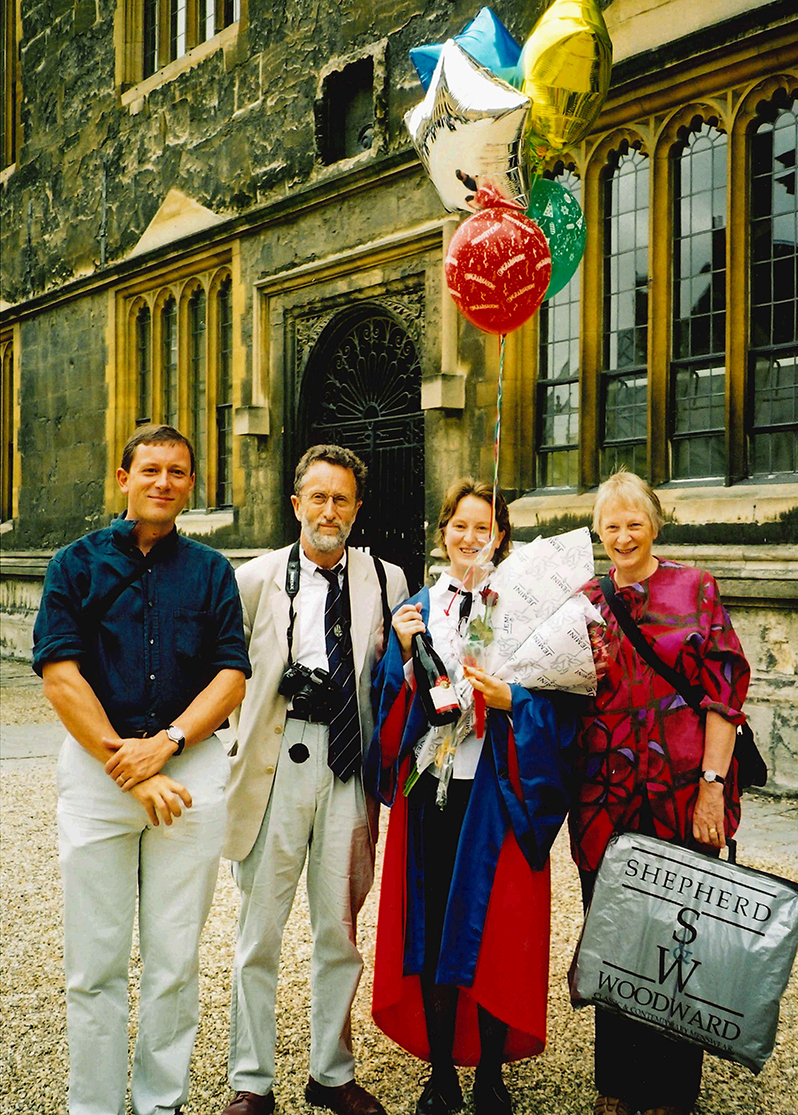
Bob returned to Oxford when his daughter Helen received a DPhil. l-r George, Bob, Helen, Barbara.
Wherever he was in the world, Bob found a sense of place through urban walks. For Bob, whether with a gaggle of students, visitors, family, friends or conference delegates in his wake, the city was a living lab with historical issues explored in situ. These ideas are explored in his final book Restoring Medieval Edinburgh in the Nineteenth Century: Architecture, Heritage and Scottish Identity. Edinburgh University Press (forthcoming, 2027), completed by his daughter Helen and widow Barbara.
In 2003, Bob and Barbara moved to the Scottish Borders to renovate previously derelict farm cottages to create a home for themselves alongside Bob’s somewhat extensive 40-tonne book collection. From an empty field alongside the cottages they created an apple orchard and planted many local and historical tree varieties.
He is survived by Barbara, their children, Helen and George, and grandsons, Alexander and David Robert.
Kindly provided by his daughter Helen